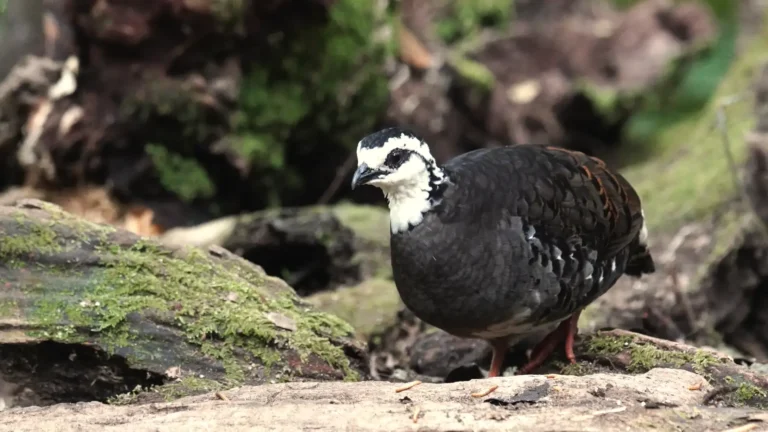
The Javan Green Peafowl (Pavo muticus muticus) is a subspecies of the Green Peafowl (Pavo muticus) that is only found on the island of Java. In the past, this bird was widespread in various corners of the island, but over time and increasing threats to its habitat, its existence is now limited to several conservation areas.
Some locations that are still home to this bird include Ujung Kulon National Park, Baluran National Park, Meru Betiri National Park, and Alas Purwo National Park.
The Green Peafowl is known as a large bird with a body length ranging from 100 to 250 cm. Male peacocks have larger bodies than females. The lifespan of this bird can reach two decades or around 20 years, with a body weight of between 3.8 to 5 kg.
This bird has a very striking appearance with a dominant sparkling green color combined with blue nuances. On the chest, the feathers form a pattern resembling green scales. The Green Peafowl also has an upright crest on its head, adding to its charm and elegance that gives a unique and exotic impression.
In addition to being found in Indonesia, this species is also spread across several other countries, such as Myanmar, China, Cambodia, Laos, Thailand, Vietnam, and India. However, the population on Java Island has distinctive characteristics that distinguish it from populations in other countries.
The Javan Green Peafowl is an omnivorous bird that has a diverse diet. Its main food consists of seeds, fruits, insects, frogs, rodents, and small snakes. With fairly good hunting skills, this bird can catch its prey deftly.
The main habitat of this bird includes various ecosystems, such as open forests (including teak forests), savannas, and mangrove forests in coastal areas. The Green Peafowl also prefers areas with fairly dense vegetation cover but still has open space for activities.
This bird reproduces by laying eggs or is oviparous, where females usually lay between 3 and 6 eggs in one laying season. The egg incubation period lasts for 26 to 28 days until it finally hatches. Male peacocks are known to be polygamous, meaning that one male can mate with more than one female.
The mating season usually takes place between April and June. During this period, male peacocks will grow long tail feathers, which can even reach three meters. These tail feathers are often referred to as trains or ‘trains’ which are used as an attraction to attract females. However, after the mating season ends, these tail feathers will fall out naturally.
Indonesia has several conservation areas that are still habitats for the Javan Green Peafowl. One of them is Baluran National Park in East Java, which has a population of around 400 peacocks living freely in the wild.
In addition, this bird can also still be found in several other national parks, although their numbers are increasingly limited due to various environmental threats. The Green Peafowl also has a distinctive loud voice, similar to a trumpet, which is often heard at sunrise and dusk.
When entering the mating season, male peacocks will expand their beautiful tail feathers to attract females, while also defending their territory from other males who try to approach. They forage by scratching leaves on the ground, similar to jungle fowl.
The Green Peafowl is often associated with legends and mythology, especially in Chinese culture, where this bird is considered the prototype of the phoenix which symbolizes immortality and nobility. In fact, in Chinese history and legend, this bird is known as the ‘king of all birds’.
However, the Green Peafowl population is currently increasingly threatened by poaching, habitat destruction, and illegal trade. Therefore, public awareness of the importance of conservation is needed.
With increasing understanding of this species, it is hoped that the public will care more about the survival of the Green Peafowl and participate in conservation efforts. As a bird that has extraordinary beauty and an important role in the ecosystem, the Javan Green Peafowl is one of the natural treasures that must be preserved so that it continues to exist in the wild for future generations. **